
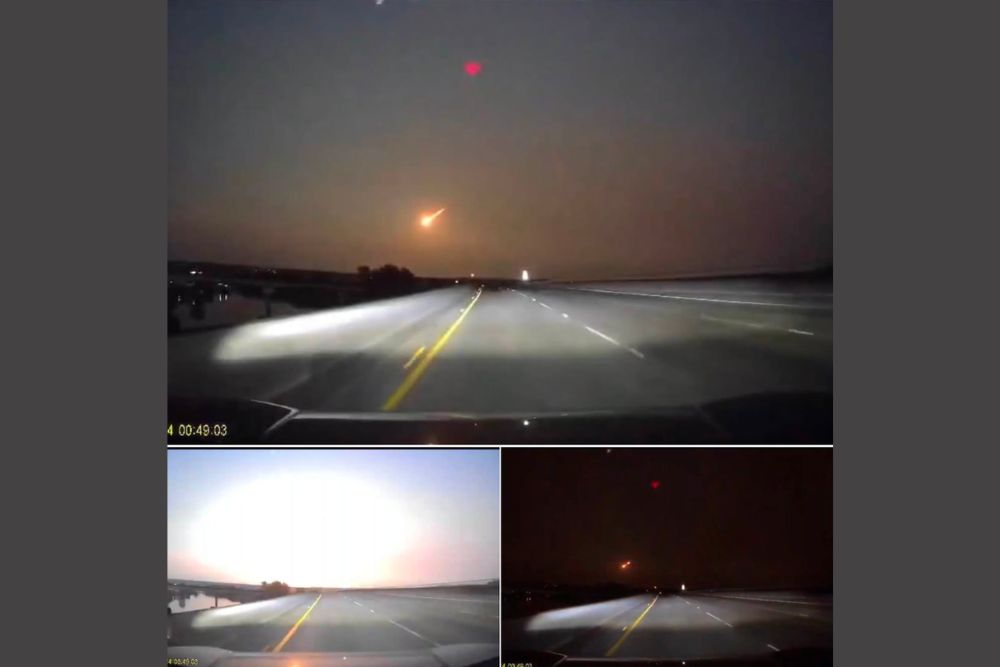
WASHINGTON — NASA has released new details on Wednesday’s incredible fireball over Washington state, confirming that hundreds of eyewitnesses across Idaho, Oregon, Washington, and British Columbia filed reports on the American Meteor Society website after the bright fireball was seen at 12:48 a.m. Pacific Daylight Time on the morning of August 14.
Analysis Traces Fireball’s Path From Soap Lake to Sim’s Corner
An analysis combining hundreds of eyewitness accounts with data from three publicly accessible cameras and the Geostationary Lightning Mappers on the GOES satellites shows that the fireball first became visible at an altitude of 48 miles above the Washington town of Soap Lake, moving north at 33,000 miles per hour.
The object, a small piece of an asteroid about 16 inches in diameter weighing approximately 170 pounds, traveled 36 miles through the upper atmosphere before fragmenting 28 miles above Sim’s Corner.
Fragmentation Released Energy Equivalent to Ten Tons of TNT
When the object broke apart, the fireball unleashed an energy of 10 tons of TNT, creating a pressure and shock wave that propagated to the ground, causing the booms reported by some eyewitnesses. This explosive release explains the audible booms that accompanied the visual spectacle for observers on the ground.
Doppler weather radar indicates that some small meteorites may be on the ground in the area, suggesting fragments of the object may have survived the atmospheric breakup and reached the surface somewhere near the fragmentation point.
Event Confirmed as Background Sporadic Meteor Unrelated to Perseids
This fireball was not part of the Perseid meteor shower; it was a background sporadic meteor, according to NASA’s analysis. This distinction clarifies that the dramatic event was unrelated to the ongoing Perseid activity that had been drawing skywatcher attention around the same time.
The timing coincidence with the Perseid shower likely contributed to initial public interest, though the confirmed sporadic nature means the fireball originated from an unrelated asteroid fragment rather than debris associated with the comet Swift-Tuttle.
Video From Everett Captures Meteor One Hundred Twenty Five Miles Away
A sequence of dashcam screenshots captured in Everett, Washington, approximately 125 miles west of Soap Lake as the crow flies, documents the meteor’s appearance, its explosive fragmentation, and the immediate aftermath, all within fractions of a second of each other.
The visibility of the event from such a significant distance underscores the fireball’s brightness and altitude, consistent with NASA’s analysis showing the object became visible at 48 miles above the earth’s surface before its dramatic breakup.
Leave a Reply