
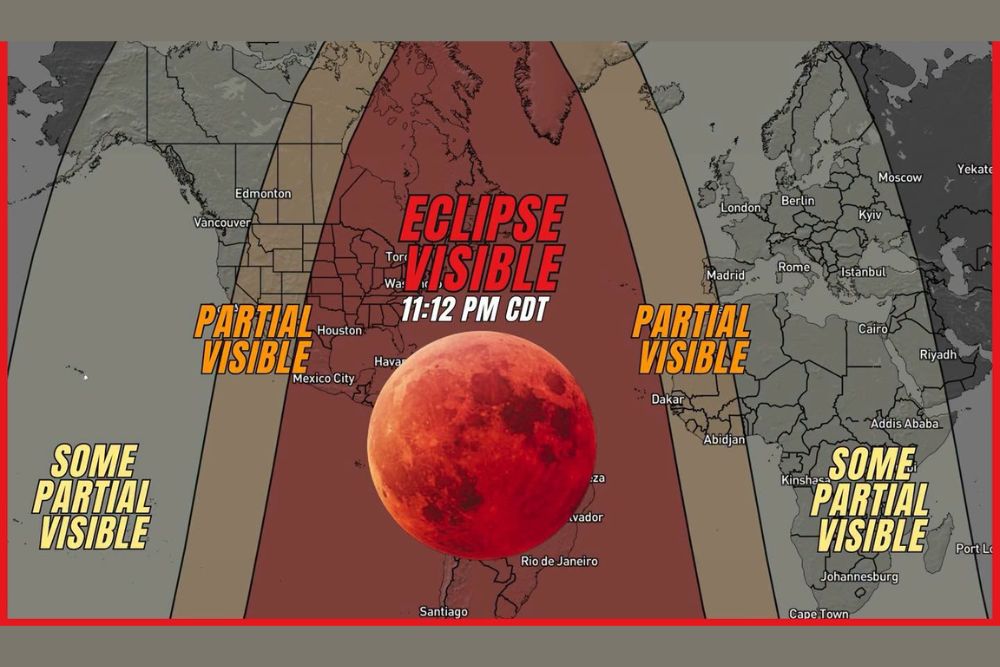
UNITED STATES — Skywatchers across much of the United States will have a chance to see a deep partial lunar eclipse the night of August 27 into August 28. At its peak, about 93 percent of the moon will be covered by Earth’s dark inner shadow, with much of the moon potentially taking on dark red, orange, or copper colors during the event.
Eclipse Timeline Runs From Evening Into Early Morning Hours
The partial eclipse begins at 9:33 p.m. Central Time on August 27, with greatest eclipse occurring at 11:12 p.m. that same night. The partial phase then continues until it ends at 12:52 a.m. on August 28, giving skywatchers a multi-hour window to observe the event.
This timeline places the most dramatic viewing opportunity, greatest eclipse, at a reasonable evening hour for most viewers across the country, making it more accessible than some overnight astronomical events that require staying up into the very early morning.
United States Falls Within Full Eclipse Visible Zone
The visibility map shows the United States positioned within the zone where the eclipse is fully visible, stretching across a broad swath of North America centered on the 11:12 p.m. Central Time greatest eclipse moment. This central visibility zone offers the best viewing experience for the full event.
Areas including Houston, Vancouver, and Edmonton all fall within this central visibility band, while regions farther east and west, including parts of Europe and areas approaching the Pacific, fall into zones where only partial phases of the eclipse will be visible.
Ninety-Three Percent Coverage Creates Deep Reddish Coloring
With about 93 percent of the moon covered by Earth’s dark inner shadow at the peak of the event, this deep partial eclipse will create striking visual effects, with much of the lunar surface potentially taking on dark red, orange, or copper hues characteristic of significant lunar eclipses.
This high percentage of coverage means the visual experience will closely resemble a total lunar eclipse for many observers, even though a small sliver of the moon will technically remain outside Earth’s darkest shadow throughout the event.
No Special Equipment Needed for Safe Viewing
Unlike solar eclipses, no eclipse glasses are needed to safely view this lunar event, meaning skywatchers simply need clear skies and a view of the moon to take in the display. This makes the event far more accessible than solar eclipse viewing, which requires specialized protective eyewear.
Residents across the United States are encouraged to mark their calendars for the evening of August 27 and hope for clear skies, given the multi-hour window and dramatic coloring expected during this deep partial lunar eclipse.

Leave a Reply